


The Hidden Aftermath of Helene: Why WNC Pond and Lake Retaining Walls Are Failing Now; Repair them soon!

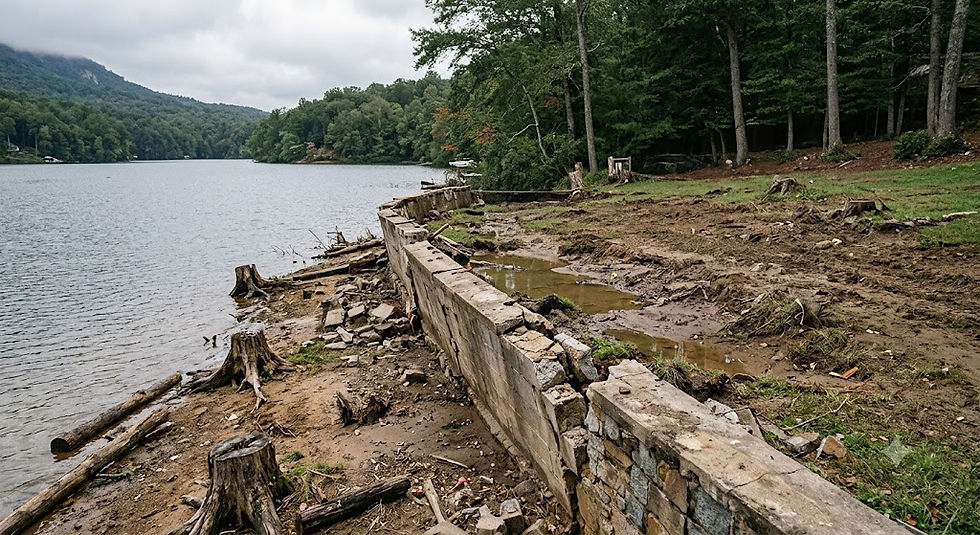
It has been well over a year since Hurricane Helene reshaped the landscape of Western North Carolina, but the ground in the Black Mountain area is still telling the story. While the immediate debris was cleared long ago, a delayed crisis is unfolding along our local waterfronts and retention basins: the progressive failure of pond, lake, and sea walls.
If your property’s water retaining walls are suddenly leaning, cracking, or showing signs of collapse this summer, you aren't alone. Here is why it is happening now, what to look out for, and how to fix it before winter.
The Delayed Effects of Hydrostatic Pressure on WNC Retaining Walls Without Repair
Retaining walls built along water don't usually fail because of the water in the pond or lake — they fail because of the water behind the wall.
Hurricane Helene dumped an unprecedented volume of water into our soil. This massive saturation drastically increased the hydrostatic pressure pushing against the back of bulkheads and retaining walls. Even if a wall survived the immediate storm, the foundational soil and drainage gravel behind it were often displaced or clogged with silt.
Over the last two winters, freeze-thaw cycles expanded and contracted this trapped moisture, slowly pushing the structures outward. Now, as we move through summer, the cumulative stress has reached a breaking point for many aging or compromised walls.
Signs Your Water Wall is Failing
Catching a compromised wall early can be the difference between a controlled remediation and a catastrophic blowout. Look for these red flags:
Sinkholes or depressions: Small dips in the soil directly behind the wall indicate that water is pulling the dirt through the wall and washing it away.
Bowing or leaning: Sight down the top line of your wall. If it resembles a bow rather than a straight line, the structural tie-backs have likely failed.
Clogged weep holes: If water isn't steadily draining through the designated weep holes after a heavy summer storm, pressure is building up behind the structure.
Cracking concrete or shifting stone: In masonry walls, stair-step cracks are a primary indicator of foundational settling.
Navigating NC Legal and Engineering Requirements
Repairing a waterfront retaining wall in WNC North Carolina isn't as simple as bringing in an excavator. Waterfront construction is tightly regulated by state and local authorities to protect water quality, manage stormwater runoff, and ensure structural safety. Attempting repairs without the proper oversight can lead to severe fines and forced reconstruction.
Engineering Mandates: In North Carolina, any retaining wall system with a cumulative vertical height greater than five feet (including the buried portion) must be designed under the responsible charge of a registered Professional Engineer (PE).
Environmental Oversight: Depending on the water body and the scope of the earth disturbance, your project will likely require approved Erosion and Sediment Control (E&SC) plans, and potentially a 401 Water Quality Certification from the NC Department of Environmental Quality (DEQ).
Local Watershed Rules: Municipalities and county governments in Western NC enforce specific setback requirements, impervious surface limits, and floodplain development permits that must be cleared before ground is broken.
A Turnkey Solution: From Blueprint to Final Inspection
Navigating the bureaucratic red tape while trying to save a failing wall is overwhelming for property managers and homeowners alike. As an NC Licensed Landscape Construction Contractor (License Number CL1943) and SBA-certified veteran-owned small business, we bring precision and strict compliance to the entire lifecycle of your project. We manage the process from start to finish so you don't have to act as the middleman between contractors, engineers, and the government.
Engineering: We coordinate directly with licensed structural and geotechnical engineers to design a wall system that meets NC building codes and directly addresses the hydrostatic pressure issues unique to your site.
Permitting: We navigate the NC DEQ, local watershed authorities, and county building departments on your behalf, ensuring all E&SC plans, floodplain certifications, and structural permits are secured prior to starting work.
Construction: Operating as a fully Licensed NC Landscape Construction Contractor (CL1943), our crews execute the heavy earth-moving, drainage remediation, and structural building exactly to the engineered specifications.
Post-Construction Approvals: We handle the final inspections, ensure the site is fully stabilized with appropriate riparian vegetation, and secure the official close-out letters and certificates of compliance.
A Note for Commercial Property Managers
For HOAs, commercial complexes, and municipal properties, a failing retention pond wall is a severe liability that cannot be deferred. Summer is the critical window to execute these heavy-machinery repairs before the ground freezes and the weather turns unpredictable.
Securing your property's heavy infrastructure now is the first step in winter preparedness. While we are assessing and remediating your landscape and drainage this summer, it is the ideal time to discuss and lock in your winter snow and ice control contracts. Securing your winter property management early ensures you are prioritized when the first major freeze hits.
Don't Wait for the Next Storm
Whether you are dealing with a compromised residential creek bank or a failing commercial retention pond, early intervention saves time, money, and property.
Protect your property line before the winter weather sets in. Reach out to A Lawn A Day Landscaping, LLC at info@alawnaday.com to schedule a site assessment and structural grading evaluation.


Comments